
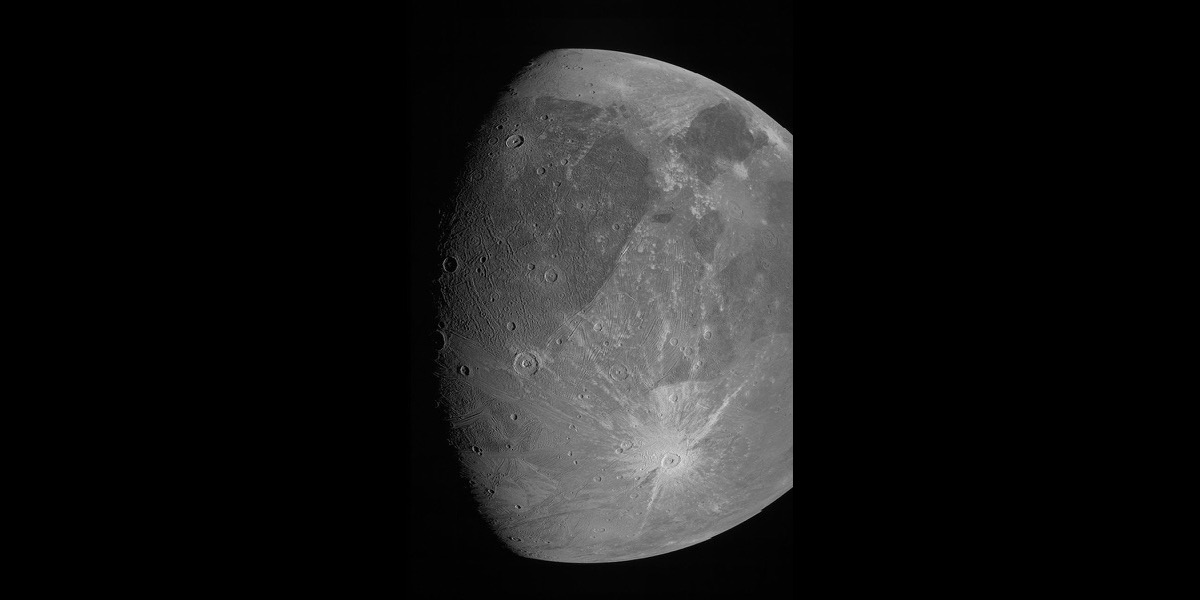
The largest moons in the Solar System are worlds in their own right: some preserve ancient impacts, others hide oceans or sustain volcanoes. Ganymede leads the list, but our own Moon also makes the top five. This countdown gives astronomy beginners a practical answer to “which moons are biggest?” and a feature to recognize on each world.
We rank known natural satellites by mean diameter, counting down from #10 to #1. Values are twice the mean radii in JPL’s physical-parameters table, rounded to the nearest kilometer, checked on 5 October 2026. Mean radius describes a sphere of equivalent volume; it is not a maximum equatorial measurement. This is a size ranking, not an editorial score for scientific importance.
Rhea and Oberon are separated by only about 4 km using the unrounded central values. Their quoted radius uncertainties overlap, so that pair’s order should be read as an order of estimates. Smaller famous moons such as Enceladus and Pluto’s Charon fall outside the top ten. Images use different scales and, where indicated, composite colors.
For another comparison of size, explore Topnilo’s tallest-buildings countdown. Our related space-milestones editorial preview introduces the exploration theme.
Image: Ganymede, preliminary JunoCam green-filter view. NASA/JPL-Caltech/SwRI/MSSS. Image reuse terms.